

 Mike O'Connor
As one of cycling’s most recent boom segments, gravel riding has driven a wave of rapid technological change in recent years. The early generation of gravel bikes, at least those labelled as such, were essentially reworked cyclocross bikes, a category that had remained largely unchanged for years and where progression has been somewhat limited by the UCI’s restrictions on tyre width.
But gravel is a bit different. Not bound by the UCI’s pesky restrictions, over the past few years we have seen many gravel bikes diverge significantly from their ‘cross brethren, as tyres got wider, frames got more stable, and bikes became increasingly capable across mixed terrain, while all still maintaining the drop-bar aesthetic we’re familiar with.
And while we’ve finally seemingly settled on somewhere around 45mm being roughly the tyre width of choice for most riders in the gravel world, another change could already be coming, and it’s a big one.
Rolling along
While we weren’t able to attend ourselves this year, Sea Otter doubles as one of the largest trade shows in the US and also acts as a pretty handy bellweather for trends in cycling, with many major and not so-major manufacturers showing off new products at what is the world’s largest cycling festival.
And, according to many of the press who attended this year, 32-inch wheels were all the buzz around the trade show gazebos. But are we ready for a new wheel size?
Is 32-inch a good fit for gravel?
For many riders, the appeal of a gravel bike lies in its versatility. Think quiet back roads, long mixed-surface routes, and a blend of speed and comfort. It’s the kind of riding that would leave you feeling ‘overbiked’ on most mountain bikes, which tend to trade outright speed for control and cushioning.
But as gravel bikes have become more capable, and the kind of terrain they are able to tackle becomes more extreme, the question becomes whether they are still serving that original purpose of being a do-it-all bike, or drifting toward something else.
At a glance, the benefits of going to a bigger wheel size does kind of make sense for this new world of riding – larger wheels can smooth out rough surfaces and help maintain momentum, particularly when the terrain turns uneven.
Riders who have tested 32-inch setups often describe a planted, stable feel that comes alive once the bike is up to speed. On paper, that sounds like it suits a lot of gravel riding.
But even with shifts to rougher surfaces, most gravel riding still happens on relatively fast, predictable terrain where responsiveness and efficiency are still just as important as comfort.
With a 32-inch size wheel, there will inevitably be more weight, especially in the parts of the wheel that influence acceleration the most. You would expect bikes with the big wheels to feel slower to get up to speed, while their handling could lose some of the sharpness that riders associate with drop-bar bikes too.
At the same time, to manage the huge wheel clearances needed, frame geometry also needs to become longer and more stable, which could further dull that lively feel. However, you could also argue that the larger wheel size would suit taller riders better.
For some riders, all these points make for a worthwhile exchange. For others, it starts to blur the line between gravel and mountain biking, and also shows how even gravel riding is rapidly diverging – just like mountain biking has XC, Enduro and Downhill disciplines with vastly different bikes for each, perhaps gravel is heading the same way.
The change is already coming
For now, while there are 32-inch gravel bikes out there, they remain firmly in the custom, boutique, or prototype space. But that is changing, and certainly in the MTB space, the tech is progressing rapidly.
Schwalbe has confirmed it is going all-in on the new wheel size, and Maxxis has already been there for some time. It released its 32in Aspen cross-country mountain bike tyre at Eurobike 2025, with its brand manager Mike Hörner confirming that the brand had expected to have its 32-inch tyres ready for the Olympics back in 2024, but the wider bike tech wasn’t quite ready for the tyres at the time.
The UCI has also announced that the new wheel size will be permitted in its MTB events.
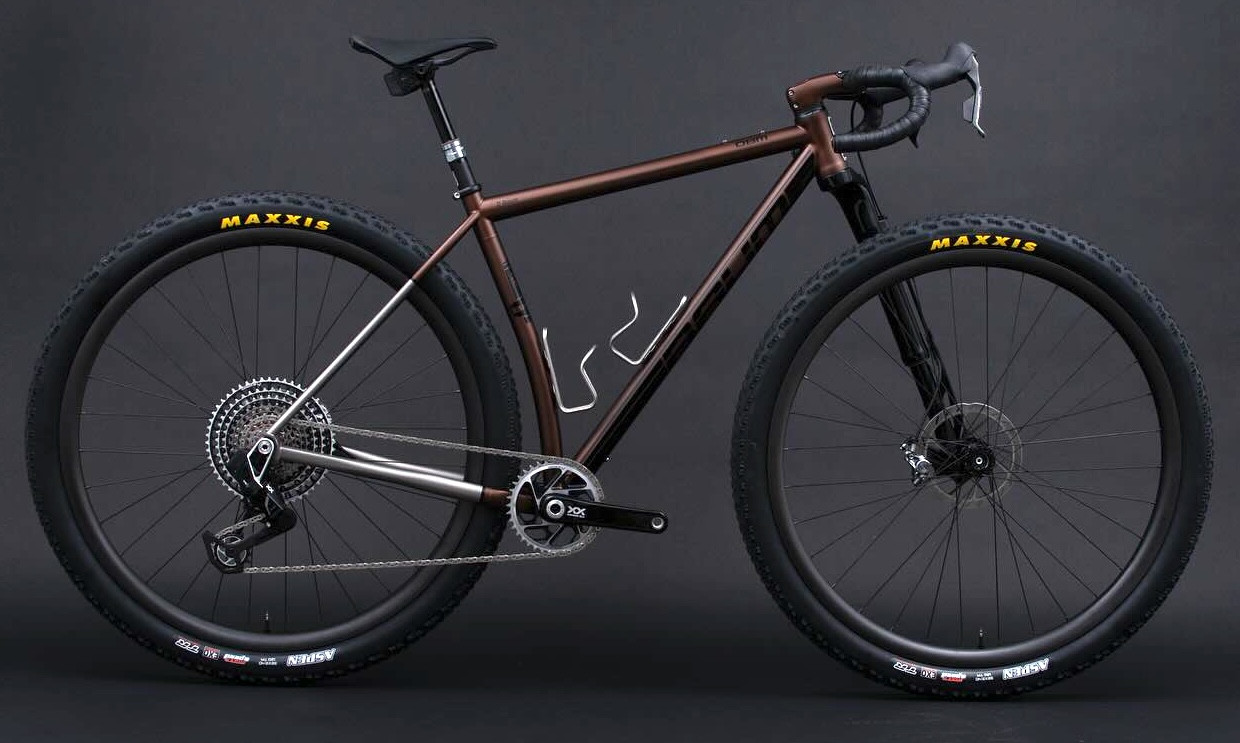
In the gravel space, Geelong manufacturer Baum’s quite stunning DBM is evidence that there is a market for these bikes, although the company is aware it’s a niche one.
Its founder Darren Baum says its original prototype was initially developed for a 200cm tall rider, and it sees benefits in the big wheels for riders not traditionally served by ‘typical’ bike sizes. It is now accepting orders for the DBM as of February.
Sea Otter also saw well-known manufacturer Salsa debut its 32-inch Fargo platform, with confirmation that framesets will arrive later this year. It says the Fargo 32 and Fargo Ti 32 will come in SM–XL sizes designed to fit riders from 5’2″-6’7″.
But while 32-inch gravel bikes are starting to appear more often in trade show conversations and experimental builds, that does not necessarily mean all riders are asking for them. You just have to look at any of the comments on social media about the new wheel size to see it remains a controversial topic.
So where does all this leave us? You could argue that while 32-inch prototypes have proven the concept is technically possible, which is interesting in itself, they still have not really answered the bigger question: whether riders actually need them or whether they solve a problem most gravel cyclists genuinely experience.
Either way, it is a technology worth keeping an eye on as it develops.

Mike O’Connor – A keen cyclist, runner and photographer, Mike O’Connor is the Editor of Bicycling Australia. He manages the BA website and social media, and loves promoting the achievements of Australian cyclists.

I’m happy with the 700 x 50mm Maxxis Ramblers on my Avanti Gran Durance. I find they are ok at faster speeds on open terrain but also not too bad at taking the sting out of rougher stuff. I think 32 inch would we faster but not sure if the weight and loosing the nimble feel is worth it ?