
 Anthony Tan
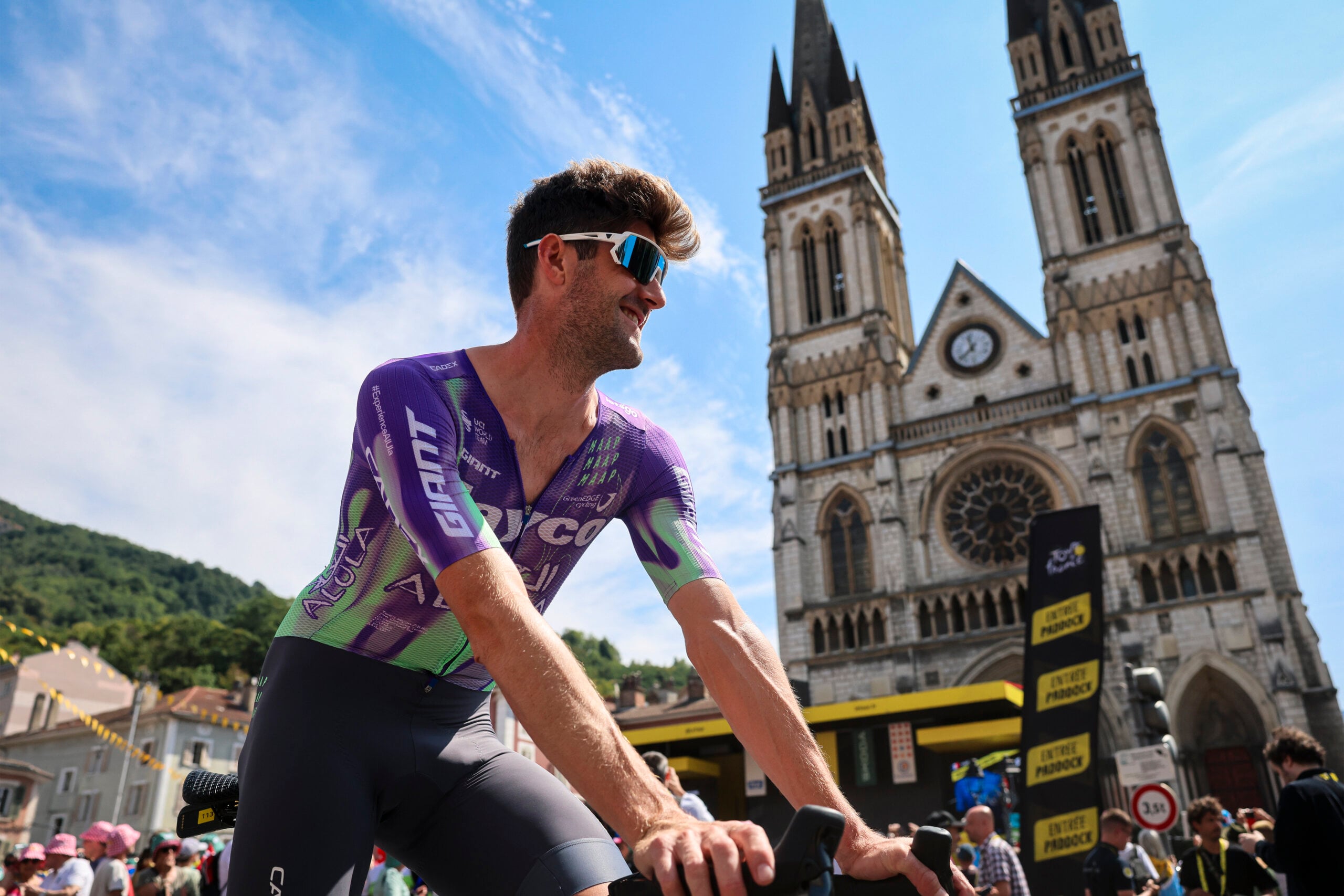
Luke Durbridge just rode his twelfth and final Tour de France. Over the coming months leading to his retirement in January next year, there’ll be a lot more lasts – including some intriguing reflections from a career well spent.
It was Saturday, July 25 in Le Bourg d’Oisans. Just one day out from Paris, Luke Durbridge was understandably philosophical. And a little angry, too.
Along with his six remaining Jayco AlUla team-mates (Kelland O’Brien finished outside the time limit on Stage 4), he was at the start of the penultimate leg and final mountain stage of the 2026 Tour de France – also his final mountain stage, at least as far as Le Tour was concerned.
The day before, the peloton raced 127.9 kilometres from Gap to Alpe d’Huez. Despite there being 3,500 metres of vertical elevation, the average speed of stage winner – and maillot jaune since the sixth stage – Tadej Pogačar was a blistering 38.767 km/h.
“A ridiculous day in general,” Durbridge called it.
The West Australian didn’t do too badly, in fact. He finished 103rd on the stage, in a group of seven containing the champion from the 2019 Tour, Egan Bernal, and multiple Tour stage winner Michał Kwiatkowski, 28 minutes and 39 seconds behind Pogačar.
“We’re going to have to do something about (limiting) the gears, I reckon,” he told Daniel Friebe of The Cycling Podcast.
“We’re going to have to restrict the gears. Like, we’re going so fast, and there’s only more and more road furniture. If everyone has a (maximum gear ratio of) 53×11 on, then I think it will (lower the speeds).
The problem is now, if you’ve got the 10 (sprocket at the back and) you’re on SRAM, if you’re in a bad position, you can move to the front again , while before you just spun out.
“Once you establish position, the peloton stays in one line. You can’t go from front to back. But now you can go from front to back.
“And you’re just going to have to move the motorbikes. (The organisers should use) drone footage or something like that (instead). You’re going to have to sort that out, because what happened yesterday (on Stage 19) is also kind of ridiculous with the amount of motorbikes and the way we were going over these rollers and these downhills. We’re talking like 70 k’s an hour on the flat.”
Earlier this year, after his eleventh and final showing at Paris-Roubaix, Durbridge, in his 15th season as a professional cyclist, let it be known that 2026 would be his last full season in the pro peloton.
The 35-year-old said he would hang up his race wheels on January 31 next year, following an Australian summer of cycling that will likely include the national championships (count four time trial and two road titles on his palmarès), the Tour Down Under and Mapei Cadel Evans Great Ocean Road Race.
If he goes back to Europe, it won’t be to race bikes.
For Jayco AlUla it was a good Tour: they won a stage with their Swiss rider Mauro Schmid, easily the best-performer from their team since the start of the season, on Stage 13.
Schmid also finished in second place on Stages 17 and 18. In fact, if it wasn’t for him, the team wouldn’t have finished in the top three on any stage and their Tour would have been deemed a failure, just like the eleven teams who did not win a stage or jersey classification this year.
Durbridge, who would end his final Tour 107th overall – 5 hours, 13 minutes and 26 seconds adrift of five-time champion Pogačar – never placed inside the top hundred on any of the 21 stages.
Not that it seemed to bother him. His job, as it often has been when he races a Grand Tour, was road captain. Making crucial, often split-second, decisions on the road when the sport directors back in the car have no idea what’s going on – or, even if they do, occasionally overruling them.
Out of the 12 Tours de France he’s done – of which he completed 10 – his best stage placing was 19th, achieved in 2014; an individual time trial on Stage 20 (the winner was Tony Martin of Germany).
His best GC result was in 2021, when he was exactly 100th on the classement général – 3 hours, 28 minutes and 5 seconds behind Pogačar, who won his second Grande Boucle with the same carefree aplomb he won his first.
Alas for Jayco AlUla, Schmid’s annus mirabilis did not go unnoticed and he will be leaving the team by year’s end, bound for Pinarello-Q36.5 on a three-year, multi-million Euro contract through to 2029.
For the 26-year-old it will be his fourth team in seven years; somewhat unusual in the real world but perfectly normal in the professional cycling milieu.
According to Al, my AI friend I sometimes consult (who did not write this column, by the way), the average career of a pro cyclist typically lasts eight to ten years, so one must make hay while the sun shines.
The ever-present dangers of this profession mean one’s career (or, in some cases, life) can be truncated or cancelled at any time, so, from a pragmatic point of view, it’s better to stay loyal to your bank manager than your team manager.
It thus makes Durbridge, who, by the time he retires, will have spent his entire career with the same team, albeit under a number of names, an outlier, an anomaly. If you include the two seasons he did with the Jayco Skins Continental team that’s 17 years under one employer – that of course being GreenEdge owner Gerry Ryan.
It will be a moment of poignancy on January 31 next year, for Durbridge is the last surviving member of the original GreenEdge crew that made their WorldTour debut in 2012.
Without Ryan’s support over the past three decades Australian cycling – and its alumni – would not be where it is today; perhaps Durbo’s loyalty lies more with him than the team per se.
In my conversations with him early in his career and from what I’ve heard and read, Durbridge is not some fuddy-duddy looking to stifle technological or physiological progress. He’s speaking as someone genuinely concerned for the current and future generations of pro cyclists.
He believes the recent trend for many riders to start their pro careers a few years earlier than when he began (Durbridge was a few months short of his 21st birthday when he debuted for Orica-GreenEdge), often with larger salaries but greater pressure to perform almost straight away, will ultimately lead to shorter career spans than he enjoyed.
“(The careers are) definitely going to be shorter. The thing is though, salaries are (sometimes) triple as well. It’s one of those things; (it’s like) you’re a CEO of a company, you’re on a big salary, you got the big responsibility.
“It’s kind of the same (in cycling),” he said. “You’re a young guy and you’re on millions of dollars.”
It’s not just the likes of 19-year-old Paul Seixas of Decathlon CMA CGM, Durbridge added, who finished a highly creditable fourth overall on debut and is widely considered (or rather, hoped) to be the one to break what is now a 41-year drought since last the Frenchman won the Tour, that being Bernard Hinault in 1985.
The West Australian referenced the situation confronting Spanish footballer Lamine Yamal, who in 2023 made his debut for FC Barcelona at 15 years and 9 months and has a performance-based contract with the club till 2031. Playing for Spain at this year’s World Cup, Yamal became the youngest player in history to win both the World Cup and the UEFA European Championship, and the third-youngest to appear in or win a World Cup final after Pelé and Giuseppe Bergomi.
“To be honest, if the salaries keep going up, then the pressure’s gonna go (up), but then the careers can be shorter,” Durbridge forewarned.
“You know what I mean? They get in, they’re amazing for five years, and then they retire and that’s it. I just see the careers will get shorter (and as a result) the contracts will get higher.
“And yeah, I feel for the kids that don’t come in and win straight away because they’re in and they’re out. You know, that’s it. It’s like the pressure of life, really, isn’t it?
“And if you don’t want it, well, there’s plenty of other people out there (who do).”
Durbridge isn’t obsessing over money – “I don’t think anyone in this peloton got into this (sport) because of earning (a lot of) money” – though money is simply part of the conversation of modern day life; more so when your first career may be just five to eight years long.
“I think it’s really important to have a really good structured family behind them,” he added.
So far, Seixas is only one and a half years into his life as a professional cyclist. Given the expectation placed upon him, he seems to be coping remarkably well. It’s like he knew his destiny a decade before it became a reality.
Pogačar, who in 2020 became the second-youngest Tour winner and the youngest since 1904 when Henri Cornet triumphed at aged 19, is in his eighth season and still going strong – quite possibly stronger than ever before.
Remco Evenepoel, runner-up at this year’s Tour, made his professional debut two days after his 19th birthday, in 2019. That year, he prodigiously won the Clásica San Sebastián one-day race and finished second in the time trial at the road world championships.
It set him on a similar path of expectation to Seixas and that has been both a blessing and a curse, for it has now been 50 years since the last Belgian won the Tour with Lucien Van Impe in 1976.
Like Pogačar, Evenepoel is also in his eighth year as a pro, and, after almost killing himself in a crash at the Giro di Lombardia in 2020, appears to be in a happy place both personally and professionally, which is reflected in his results.
Time will tell if Durbridge’s words prove prophetic.
In any case, even after his career ends, let’s hope he continues providing his insights into this often esoteric world that far less than 0.01 percent of us will ever get to occupy.
Anthony Tan
Anthony Tan - One of Bicycling Australia’s longest-serving columnists, ‘Tan Man’ has a deep passion for the sport and is a natural communicator.