
 Anthony Tan
No one would admit to schadenfreude but the absence of the world’s number one rider may have had an effect on racing more than the absence of radios in Montréal.
Every year since 2011, when two-way radios were banned at the UCI road world championships and the Olympic Games, the subject comes up for debate.
The sport’s governing body, the UCI, said it was done to make the racing more rider-led, more spontaneous, and therefore less predictable.
Proponents say that first and foremost, race radios provide safety to the riders in the form of information about potential hazards on the course, extreme weather, or a medical emergency.
Furthermore, any rider requiring mechanical assistance can immediately notify their team car. Time gaps from race motorbikes are often unreliable, say those advocating for race radios, and speeding through the peloton to provide information or instructions to one rider who must then pass that onto their team-mates makes already tense situations unnecessarily chaotic.
Well, a few Sundays ago, many say they witnessed the best road worlds in more than ten years, when American Brandon McNulty threw the bookies’ favourites out the window and, after 273.4km and six-and-a-quarter hours in the saddle, triumphed in Montréal.
The elite women’s race was perhaps more predictable though significant because Demi Vollering became only the second woman to win the Triple Crown of Cycling – that being the Giro Donne, Tour de France Femmes and road world championship in a single year.
“So there’s a lot of communication (in pro cycling). Now, there is this old traditional faction of the sport that thinks that we should do away with race radio, and we should do away with power meters, and blah, blah, blah, all these things.
Now, why do they say we should take all of these things away?
“They say because it’ll make the racing more exciting.
Well, guess what? Guess what they’re saying today?
“I told you so.”
This was Lance Armstrong talking on The Move podcast a day after the elite men’s race. Before McNulty, he also happens to be the last American to have won the worlds – which, unlike his since rescinded seven Tour victories, is a title he still owns.
“Now, there’s a lot of other factors that go into what make a race exciting or not, but you bet your ass they’re sitting at home going, see, this is what happens. Look at it, wasn’t this great. And it was.
“I think the race would have unfolded exactly the same way in terms of excitement with race radio.”
Note that Armstrong said “in terms of excitement” – not strategy or outcome.
I have been writing about the subject of race radios since 2002, when I read Belgian rider Mario Aerts, after his victory in La Flèche Wallonne, the classic that sits between Amstel Gold and Liège-Bastogne-Liège, said this: “(My sports director) Claude Criquielion told me in my earpiece to stay calm.
If I had not done this, the result would not have followed. I respected his advice to the letter. When he gave me the green light, I attacked. I then thought I could win.”
The irony of Criquielion’s advice, however, was that it was based on misinformation: he believed that one of the chasers following Aerts was Spanish rider David Extebarria. It was in fact Unai Extebarria, who was far more suited to the familiar finish up the Mur de Huy.
That Aerts nevertheless prevailed is not the point; it exemplified that even with radios, information is not always accurate – and if the information isn’t accurate, the advice or instructions won’t be, either.
Italian Paolo Bettini also credited his sport director’s instructions for his victory a few days later at Liège-Bastogne-Liège.
In 2002, cycling was at its height of popularity; television viewing figures affirmed this, as did the number of first and second division teams, rider salaries and companies vying for sponsorship rights. And so the stakes were never greater; race radios were seen by most as an evolution rather than revolution.
Back then I wrote: “The reality is that pro cycling is now big business, and a gross tactical error is no longer tolerated in a major classic or Grand Tour. Relying on gut feelings in a sport so physically and mentally taxing may not be such a great idea.”
Instead, the sage advice of a calm sports director was thus considered preferable over the old-school, rely-on-gut-instinct-when-nerves-are-frayed option, though romanticists such as myself quietly bemoaned what appeared to be an increasing lack of spontaneity and unpredictability with the increasing reliance on two-way radios.
In hindsight, perhaps the near-ubiquity of PEDs (performance enhancing drugs) had as much to do with the seemingly robotic nature of professional cycling, at least as far as the Tour de France was concerned.
For what it’s worth, Bettini would go on to win back-to-back world titles in 2006-07 – while race radios were still allowed.
Armstrong’s longtime sports director during his drug-enhanced US Postal Service/Discovery Channel heyday, Johan Bruyneel, said that, even with race radios, little would have changed on September 27 in Montréal. “It wouldn’t have changed a lot,” he said.
“I mean, first of all, they’re racing on circuits, so the whole aspect of safety and security (goes) out the window. You don’t need to be informed about the course because you know the course.”
Larry Warbasse, one of McNulty’s seven team-mates on the day, said having so many teams with everything from one to eight riders already creates “an unpredictable element” that, apart from the absence of race radios, makes the races like the worlds and Olympic road road race unique.
“For me, it’s almost nothing to do with whether it’ll make the race more exciting or less exciting,” he told The Cycling Podcast on October 2.
“It’s more like, I think not having radios would slightly favour more prepared riders because the problem is now, everyone just relies totally on the radio. And a lot of guys, they don’t look at the course.
“They just kind of do whatever the DS says in the radio. And then the problem is, like, you know, VeloViewer, this (GPS) app that we all use. For those people who don’t know, it essentially is extremely detailed maps of the course.
“They have the GPS files of all the different courses. Then you have these incredible profiles. I mean, it’s insane. And it’s an amazing tool. But the problem is, every single team has the exact same tool.”
The team from the United States also hatched a plan that other top nations didn’t expect them to prosecute: to back themselves and go in as equal favourites, to be aggressive once on the Mont Royal circuit, and to have three leaders in Matteo Jorgensen, Quinn Simmons and McNulty and to let the race decide who the ultimate leader would be.
Like the Netherlands, Belgium, France, Denmark, Mexico, Spain and Italy, the Americans were racing not just for a podium but the win.
Warbasse, who during the season rides for Tudor Pro Cycling but spent the previous five seasons with AG2R La Mondiale, also said that sports directors having access to so much information can, rather perversely, work against them: they can’t decide what to filter out, so they give their riders everything.
“I would say a lot of DSs now are scared to get in trouble if someone gets dropped or there’s a split and then their riders miss it. So then they kind of (say) way too much stuff in the radio. So if you’re (wired up to) the radios these days, it’s just constant talking. It’s just constant talking, constant talking, constant talking.”
He says it’s particularly difficult when you’re suffering and/or trying to tap out a steady rhythm, which explains why so many riders pull out their earpieces on long climbs, suffering in the gruppetto, or going for broke in search of victory; all they want is the time gap and nothing else.
Of course, there may be a much more simple explanation why this year’s worlds was arguably the best since Cadel Evans pulled off his historic coup in 2009 and is still Australia’s only elite road world champion…
The absence of Tadej Pogačar.
Personally, I think his presence (or rather, absence) has more of an effect than whether the peloton uses radios or not. This season and last, when the Slovenian changed his race program to include more one day races in the European spring, he altered the dynamic of every race he entered.
And he won far more than he didn’t. Other than Mathieu van der Poel (albeit in much fewer races) no other rider has that effect.
Excluding the GP Québec, the worst place he finished in a mass-start one day road race the last three seasons was third, at the 2024 and ‘25 Milan-San Remo.
His record in stage races is more ridiculous: since 2024 and until this year’s Vuelta he had not lost a race he entered; and until he crashed out the Spanish Grand Tour was turning into a three-week victory parade, such was his margin after just one week.
Of course, most of us wish to see Pogačar fit and healthy and racing again, but in the meantime, enjoy seeing what racing looks like without the G.O.A.T. in the peloton.
Bling not done
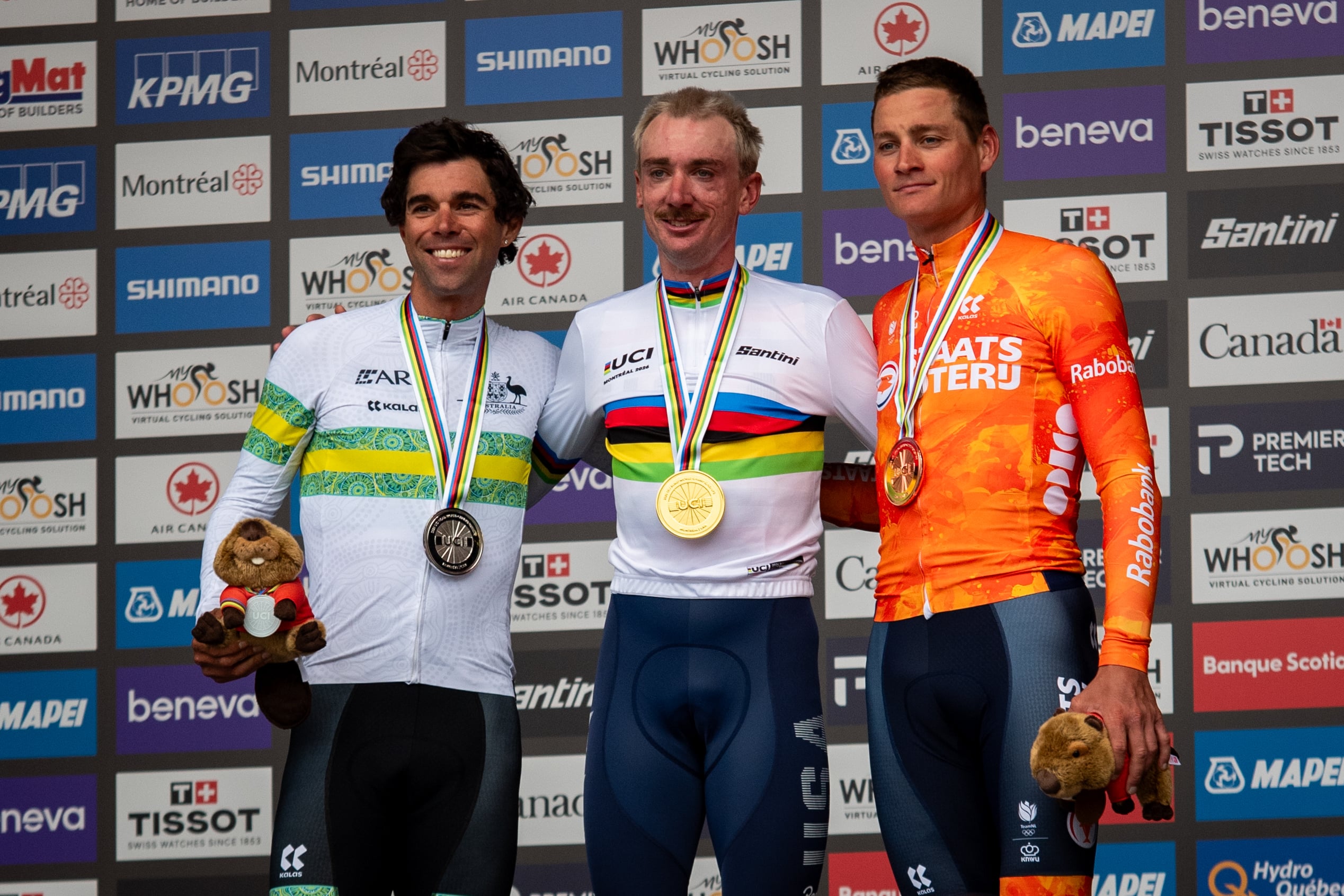
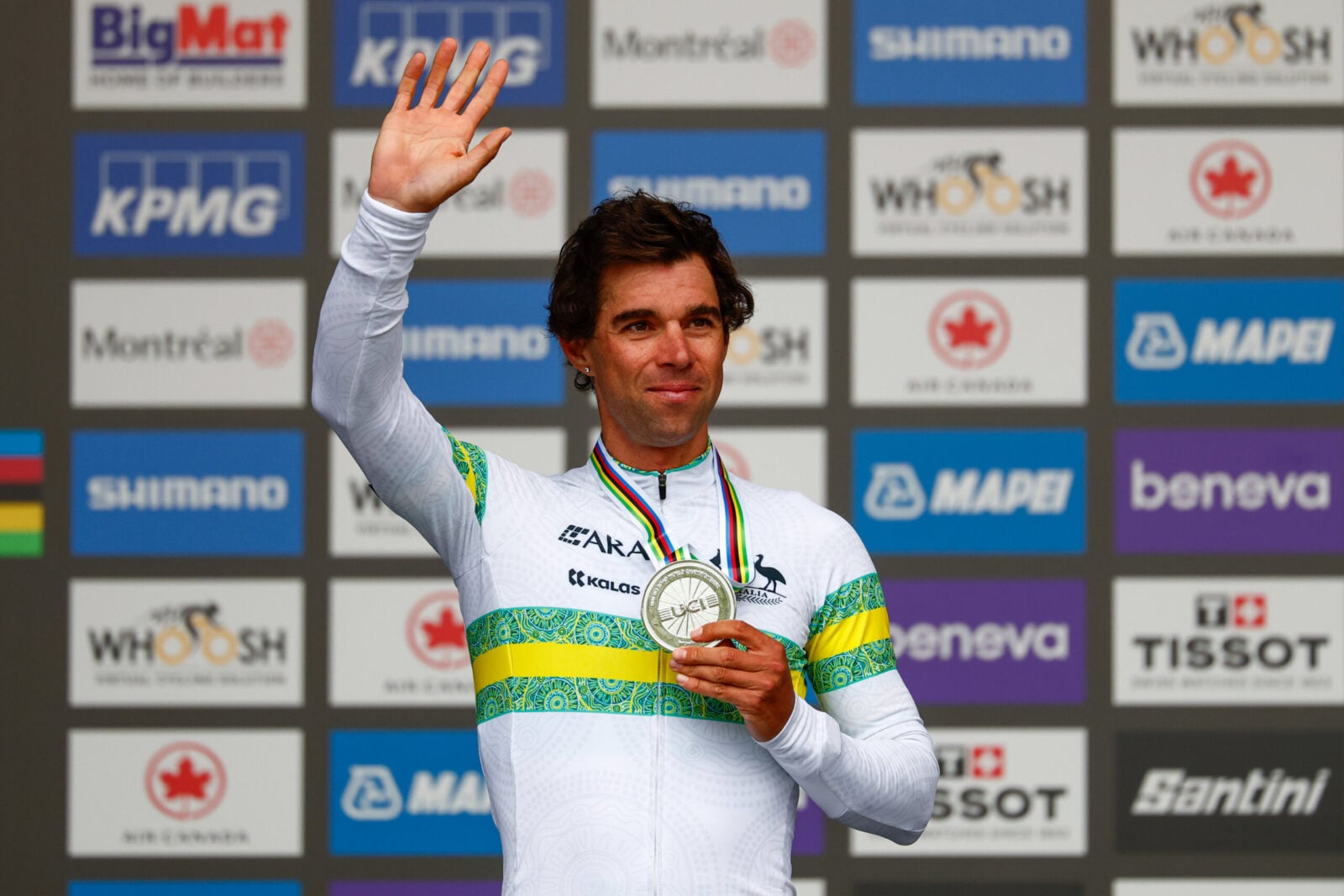
It was eleven years since Michael Matthews last finished runner-up in the elite men’s category at a road world championship and it was his fourth podium finish.
At 36, it may have been his last shot at the rainbow jersey. You’d think he’d be bitterly disappointed but when he crossed the line in Montréal, it looked like he had won.
“It’s not only the way I raced the race today after what I’ve been through the last two years with the embolism in my lungs, thinking my career was done, to breaking both my arms at start of this year and thinking my career was done (again). Now, bouncing back to being second in the world’s road race, I’m just speechless,” he said the day of his silver medal performance.
“I said to my wife at the start today, ‘Let’s just leave it all out there and be proud of the ride’ and at the end of the day make sure I finish with nothing left, and that’s exactly what happened.
“When I crossed the finish line I put my head in my hands, almost in disbelief at what just happened. Honestly, it’s just credit to my family, to the team, to all the support crew around me, that didn’t stop believing that this could happen right now. I just I owe everything to them.”
Last season, he raced just 28 days. This year, he had a win at a UCI 1.1 race in January and earned another podium finish a few days later but prior to Montréal, never scored another top-three despite a fuller race schedule that included the Tour de France.
Throughout the season he was searching for top form but never quite found it. Prior to the Worlds he finished sixth at the GP Québec but two days later at the GP Montréal he was 54th. He rode the mixed relay on September 22 where the Australian team ended fourth.
Five days later, the day of the elite men’s race, somehow, he pulled a rabbit out of the hat and was the second best cyclist in the world.
There’s one year left on his contract with Jayco AlUla. Chances are it’ll be a good one.
Anthony Tan
Anthony Tan - One of Bicycling Australia’s longest-serving columnists, ‘Tan Man’ has a deep passion for the sport and is a natural communicator.