
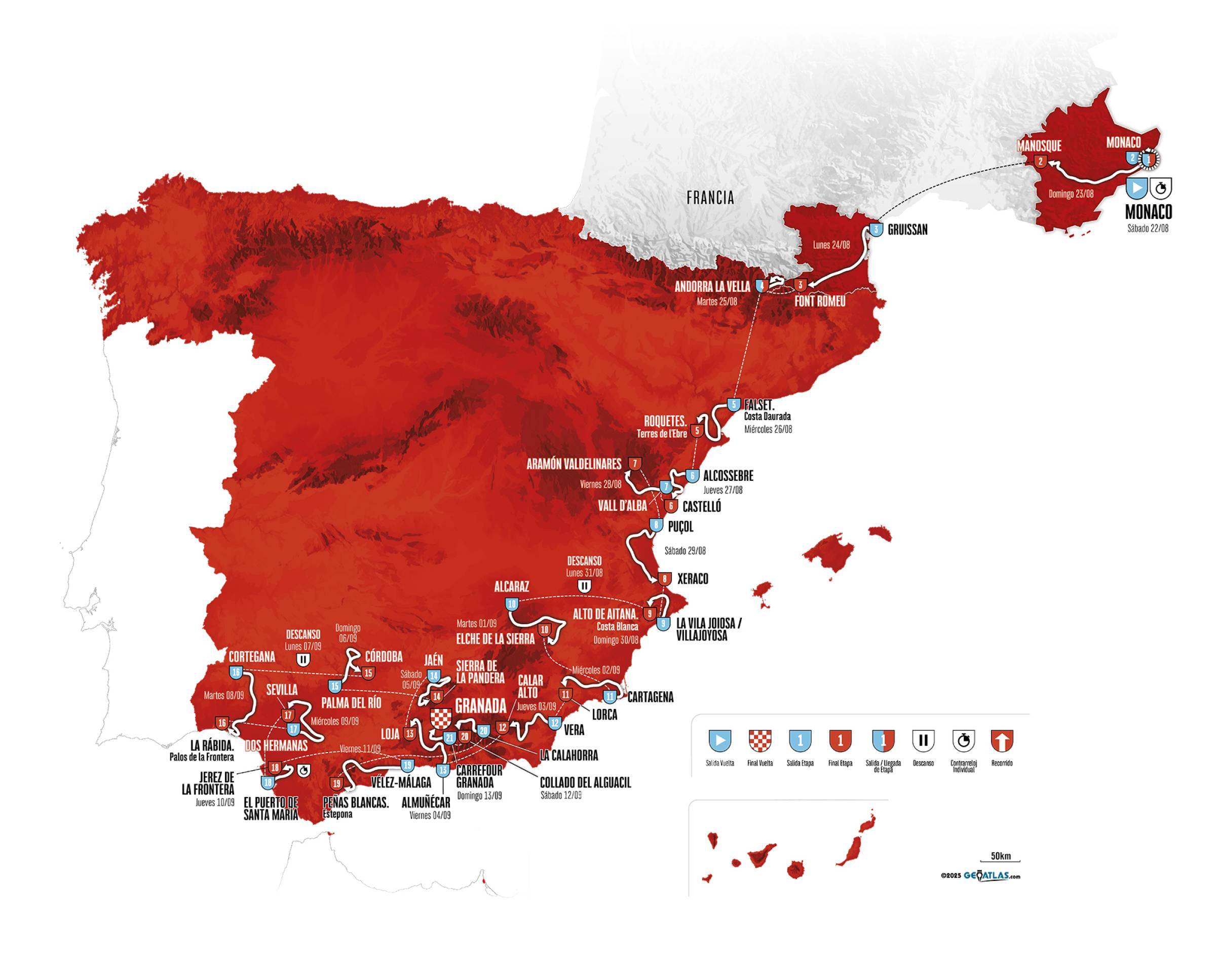
With the first week containing not a single sprint opportunity and the second boasting far more vertical metres than the third, this year’s Vuelta route is, on paper at least, the most unorthodox of the season’s Grand Tours.
If you ask the winner of ABC’s documentary competition Race Around The World, Elliot Constable, what he thinks of Monaco, he’ll tell you it’s the most vacuous place on earth and it was where “I lost my mind” due to the sheer superficiality of the place and its people.
Seventeen years ago, in 2009, when I travelled to the world’s second smallest country (after the Vatican City) to cover the start of that year’s Tour de France, I felt the same as Elliot about the place where one in three residents are millionaires.
I just didn’t belong.
But I was a professional journalist and I had an event to cover, so my squeamishness about this bizarre little joint that covers just two – yes, two! – square kilometres had to be set aside in the interests of keeping my job. (If you’d like to step back in time, you can read my race reports here.)
Admittedly, the Mediterrean seaside backdrop along the French Riviera was stunning; with a climb straight out of the blocks the 15.5km course challenging; and with Lance Armstrong, Alberto Contador, Carlos Sastre, that year’s Giro champ Denis Menchov, and two-time runner-up Cadel Evans, it was a Tour to remember.
The short, though highly technical, 9km ITT to kick off the 2026 Vuelta isn’t nearly as hard as that faced back then. Fernando Escartin, former top professional and race director of La Vuelta since 2016, said that “the riders face a quick stage where the very first leader of the race will be determined by the smallest of details”.
Given the degree of technicality, a failure to properly reconnoitre the 9km course could result in skin, rather than time, lost. Here’s hoping everyone stays upright.
Not a single sprint in Week One…
The rest of the first week is noticeable by the absence of sprint stages. Not one.
Stage 2 sees the peloton traverse a hilly path from Monaco to Manosque, the largest town and commune in the Alpes-de-Haute-Provence department in southeastern France, population circa 22,000.
With no major mountains but 3,000-plus metres of elevation gain, it’s entirely possible there’s a big breakaway and a change of leadership by day’s end.
The next day is entirely en France, ending in Font Romeu, a stone’s throw from the Spanish border and at 1,936m altitude.
For the race’s first summit finish, “It is expected to identify a group of around 20 or 30 of the strongest riders that will fight it out for the top spots of La Vuelta 26,” predicts Escartin, twice a runner-up at the race (1997, ‘98).
The mountains do not abate on Stage 3: over 104.8 kilometres the peloton must face a triplet of Cat. 1s and, roughly 5km before the finish in Andorra La Vella, a Cat. 3 by the name of La Comella (3.9km at 5.9%). Expect a race for stage honours and another for GC contenders.
Already by the fourth stage the majority of the peloton will have lost significant chunks of time, making it easier for the team of the race leader to control proceedings and breakaway specialists like Mads Pedersen (Lidl-Trek) and Wout van Aert (Team Visma | Lease a Bike) to take flight.
Escartin sees this as “one of the few clear opportunities of a sprint” – though a steepish Cat. 3 ascent topping out 25km from the line makes me think not.
In the following four stages leading to the first rest day, two days are bona fide mountain stages, one is classified medium mountain and one a token sprint opportunity.
However the medium mountain stage is a real doozy. It contains a quartet of categorised climbs and saves the hardest for last: the Cat. 1 Puerto El Bartolo measures 9.4km at 7.1% and the final three kilometres are on dirt roads before what Escartin says is a “rapid (read: dangerous!) descent” towards Castellón.
The seventh leg marks a second high altitude finale, this time to the Cat. 1 Aramón Valdelinares and off the back of four previous climbs – and all within 150 kilometres.
Two days later it’s another Cat. 1 uphill finish and with over 5,000 metres’ elevation certainly the hardest stage to date, with the race ending in Alto de Aitana.
The climb has been used four times before, most recently in 2016 when Frenchman Pierre Latour won the penultimate stage solo and Nairo Quintana became the second Colombian after Luis Herrera in 1987 to win La Vuelta.
“The heat could make this already challenging stage even tougher,” warns Escartin.
Oh yes… As for that token sprint stage on Stage 8, it’s not a guaranteed group gallop: organisers have thrown in a Cat. 2 climb that tops out some 37km from the finish in Xeraco; if I was a bunch sprinter and in a contract year, I’d be less than pleased.
A third more climbing metres in Week 2 than Week 3…
Atypically, there’s more mountain stages and more than 30 percent climbing metres in the second stanza than there are in the last (more on that later).
The common thread between weeks one and two is just the one opportunity for sprinters. Just 151.3km, the eleventh leg will likely be raced flat-out from go to whoa – but again, placement of a 9.5km long Cat. 3 some 30 clicks from home by no means guarantees the peloton arriving en masse in Lorca.
Stages 10, 13 and 15 are deemed either hilly or medium mountain. Because of what roads have gone before this day, and the second and final rest day to follow, I would surmise the fifthteenth leg on Sunday September 6, while only having a triplet of Cat. 3 ascents to contend with, is the hardest of the aforementioned three.
Says Escartin: “Córdoba’s Sierra Morena will host a winding stage with leg-breaking terrain before the final rest day. It will consist of a classic stage profile where the riders that are ahead may have an advantage during the traditional finale in Córdoba, where a reduced group may fight for victory.”
In a Grand Tour, as the days go on and the legs grow more weary, logic dictates a greater chance for a breakaway to succeed: if the teams of those placed high on the overall classification are content with the composition of the break, their advantage often balloons and in so doing their chances of victory.
Stages 12 and 14, the two high-mountain stages, are particularly nasty.
The twelfth leg, at 166.6km, is short and savage. Five evenly-spaced climbs must be traversed with the last two a pair of Cat. 1s, not to mention a summit finish at Calar Alto; at 2,168 metres the highest peak in Andalusia’s Sierra Nevada, and by day’s end more than 4,500m of climbing will have been done.
Stage 14 is again shortish but hellish: with just under 4,200m climbing a little less ascending but it’s all concentrated in the back end of the stage. The final climb to Sierra de la Pandera, where the stage ends 1,821 metres high, is as tough as Calar Alto: “Should one of the favourites have a bad day, he can kiss the general classification goodbye”, says Escartin.
On the six previous occasions the Vuelta has finished at Sierra de la Pandera only the very best climbers have triumphed: from inaugural winner Roberto Heras in 2002 to Richard Carapaz, the most recent, in 2022, with Alejandro Valverde, Andrey Kashechkin, Damiano Cunego and Rafał Majka in between.
Week Three: A mixed bag of goodies…
If the sprinters make it to the final week they’ll be (somewhat) rewarded: from the remaining six stages, one-third are likely bunch finishes.
Stage 16 contains just shy of 2,000m vertical gain but it’s virtually all in the first half; position will be crucial in the last 15-20km because the route hugs the coast to Palos de la Frontera.
The highpoint the next day is just 220m above sea level – the seventeenth leg is undoubtedly the flattest of the Vuelta – so if you want to put your Euros on a mass sprint in Seville, the Andalusian capital, this’d be it.
By Stage 18 will things be tight as a frog’s bottom or will The Pog be leading by 10 minutes?
In any case, a 32.5km ITT will provide chance for some reordering of the top 10 on GC. It’s extremely flat, it’s near the coast, it suits power riders, and you’d have to say it’s got the name of Stefan Küng (Tudor Pro Cycling) and his imposing 1.93m frame written all over it.
At 210km, Stage 19, the second-longest day of the ‘26 Vuelta, will also be one of the hardest: 4,200 metres’ elevation gain; a pair of Cat. 2s in close succession midway through the stage; and, to finish, a 18.7km ascent to Peñas Blancas (6.5% average gradient), where, on a clear day, the tourist guides say one can see all the way to Africa. (Note to editor: I’m happy to fact-check this if you’d like to send me to Andalusia for a holiday, er, um, I mean work-trip.)
The Queen stage
There’s always a queen stage in every Grand Tour and Saturday, September 12 is it for this year’s Vuelta.
Boasting 4,850 metres’ elevation gain over 186.8km, Stage 20 consists of five categorised climbs including a hat-trick of Cat. 1s and a Cima Especial (the Spanish equivalent of a hors catégorie climb at the TdF) summit finish to the Collado del Alguacil (8.3km at 9.8%).
“The double ascent towards Hazallanas (8.2km at 8.1%) and El Duque (7.4km at 8.3%) will truly affect the riders’ legs and how they approach the final climb up the Collado del Aguacil,” says Escartin.
And, taking a leaf out of the Tour de France course director’s playbook, the final stage in Granada is not without difficulty: at 99.4km it’s the shortest road stage, but in the final 40km four ascents in quick succession to the majestic Alhambra palace will put paid to the idea of a sprint to end the 81st edition of La Vuelta.
2026 Vuelta a España: The Stages
La Vuelta 26 will be made up of 21 stages and will cover a total distance of 3,275 kilometers.
- 4 hilly stages
- 1 hilly, uphill finale stage
- 4 flat stages
- 4 medium mountains stages
- 6 mountain stages
- 2 individual time trial stages
- 2 rest days
Stage 1, August 22: Monaco Individual Time Trial, 9.4 km
Stage 2, August 23: Monaco – Manosque, 214.3 km
Stage 3, August 24: Gruissan – Font Romeu, 174 km
Stage 4, August 25: Andorra la Vella – Andorra la Vella, 104.8 km
Stage 5, August 26: Falset – Roquetes, 173.4 km
Stage 6, August 27: Alcossebre – Castelló, 177.4 km
Stage 7, August 28: Vall d’Alba – Aramón Valdelinares, 149.8 km
Stage 8, August 29: Puçol – Xeraco, 171 km
Stage 9, August 30: La Vila Joiosa/ Villajoyosa – Alto de Aitana, 187.4 km
August 31: Rest Day #1
Stage 10, September 1: Alcaraz – Elche de la Sierra, 184.7 km
Stage 11, September 2: Cartagena – Lorca, 151.3 km
Stage 12, September 3: Vera – Calar Alto, 166.6 km
Stage 13, September 4: Almuñécar – Loja, 192.8 km
Stage 14, September 5: Jaén – Sierra de La Pandera, 154.5 km
Stage 15, September 6: Palma del Río – Córdoba, 189.7 km
September 7: Rest Day #2
Stage 16, September 8: Cortegana – Palos de la Frontera, 181.1 km
Stage 17, September 9: Dos Hermanas – Sevilla, 185 km
Stage 18, September 10: El Puerto de Santa María – Jerez de la Frontera Individual Time Trial, 32 km
Stage 19, September 11: Vélez-Málaga – Peñas Blancas. Estepona, 210 km
Stage 20, September 12: La Calahorra – Collado del Alguacil, 187 km
Stage 21, September 13: Carrefour Granada – Granada, 99.4 km

Anthony Tan
Anthony Tan - One of Bicycling Australia’s longest-serving columnists, ‘Tan Man’ has a deep passion for the sport and is a natural communicator.